Dressed to Narrate: How Japanese Theater's Costume Traditions Are Pushing American Designers Beyond Pure Spectacle
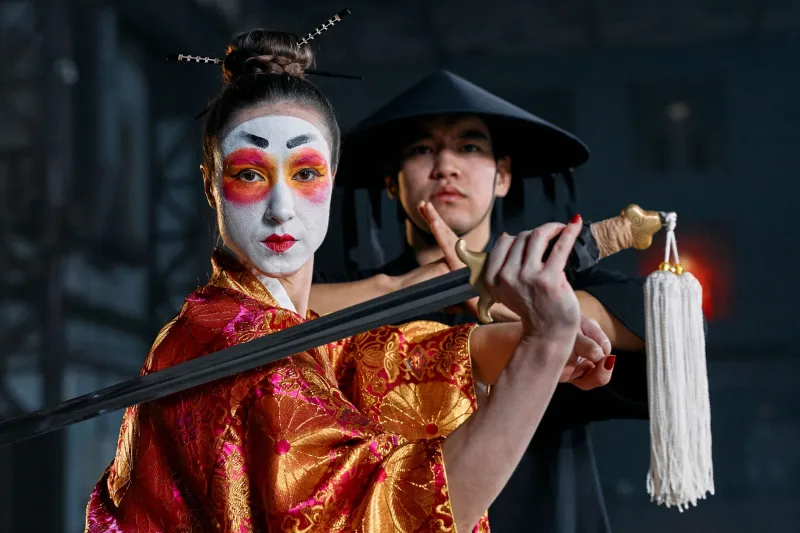
There is a moment in a traditional Kabuki production — known as hikinuki — when a performer's outer kimono is pulled away in a single, breathtaking instant to reveal a completely different garment beneath. The color shifts. The pattern changes. And the audience, without a single word of dialogue, understands that the character has undergone a profound transformation. It is theater at its most efficient and its most eloquent.
For American costume designers accustomed to measuring success in sequins and spectacle, that single moment carries an almost disorienting lesson: the most powerful garment on a stage is not necessarily the most elaborate one. It is the most intentional.
The Grammar of the Kimono
Japanese theatrical costuming operates according to a visual grammar so precise that it functions almost as a second script. In Kabuki, color is not aesthetic preference — it is biographical data. Deep crimson signals heroic virtue. Dark blue or brown marks the common person or the villain. Patterns of pine, bamboo, and plum blossom carry their own symbolic weight, communicating a character's social standing, emotional state, and moral alignment simultaneously.
Noh theater takes a different but equally disciplined approach. Its robes — often centuries old and treated as sacred objects — are deliberately understated in silhouette while extraordinary in textile artistry. The nuihaku, a robe embroidered with gold and silver thread, or the karaori, woven with intricate floral patterns, speaks to a character's spiritual or social identity through material quality rather than theatrical exaggeration. On the near-bare Noh stage, a single robe must carry the narrative weight that an entire scenic environment might bear elsewhere.
Bunraku puppet theater adds yet another dimension. Because the puppets themselves are small and the audience is at some distance, costumes must communicate instantly and unmistakably. Puppet costumers learned centuries ago that clarity of visual storytelling is not a compromise — it is the highest form of craft.
What American Designers Are Beginning to Hear
The conversation has been building gradually within American theatrical design circles. Costume designers working on productions that engage with Asian narratives — or simply seeking more rigorous design philosophies — have begun studying these traditions not to replicate them wholesale, but to internalize their underlying logic.
The core question Japanese theatrical costuming poses is deceptively simple: What is this garment saying, and to whom?
In practice, American productions have historically privileged the visual impact of a costume over its narrative function. A gown that photographs brilliantly or earns a gasp at a character's entrance may nonetheless communicate nothing specific about who that person is, what they want, or what they fear. Japanese traditions suggest that this represents a missed opportunity — that the moment an audience's eye lands on a costume is a moment of storytelling that cannot be recovered once squandered.
Several Broadway productions in recent seasons have demonstrated a quiet but meaningful shift in this direction. Rather than dressing characters in period-accurate or visually stunning ensembles that exist somewhat independently of the drama, designers are increasingly making choices that encode character psychology directly into fabric, silhouette, and color. A protagonist's costume that subtly fragments across the arc of a play, or a villain whose garments are deliberately beautiful in ways that unsettle rather than seduce — these are decisions informed, whether consciously or not, by the logic that Japanese theater has practiced for centuries.
The Discipline of Restraint
Perhaps the most challenging lesson Japanese theatrical costuming offers American designers is the value of restraint — not as a budget constraint, but as an artistic commitment.
In Noh performance, a master costumer might spend hours deciding which of two nearly identical robes best serves a particular production of a particular play performed by a particular actor on a particular day. The differences between the two garments might be imperceptible to an untrained eye. Yet the decision is understood to matter profoundly, because the robe is not decoration placed upon a performer — it is, in a meaningful sense, part of the performance itself.
This philosophy stands in sharp contrast to the instinct, common in commercial American theater, to layer and amplify: to add another element, another texture, another visual statement, until a costume becomes an argument for itself rather than a servant of the story. Japanese tradition asks designers to resist that instinct — to ask, with each addition, whether it deepens meaning or merely increases noise.
For American designers trained in environments that reward boldness and visual originality, this is not a comfortable question. But it is, increasingly, a necessary one.
Cultural Respect as Design Practice
There is an important ethical dimension to this conversation that responsible designers are navigating with care. Borrowing principles from Japanese theatrical costuming is not the same as appropriating its forms. The distinction matters.
A designer who studies the symbolic logic of Kabuki color coding and applies that logic — thoughtfully and with full acknowledgment of its origins — to an original American production is engaging in genuine cross-cultural dialogue. A designer who dresses a non-Japanese production in kimono-adjacent garments for visual exoticism is doing something categorically different, and considerably less defensible.
The most thoughtful American practitioners working in this space are explicit about the distinction. They cite their influences, engage dramaturgically with the traditions they draw upon, and remain alert to the difference between inspiration and imitation. Several have collaborated directly with Japanese designers or consulted with cultural advisors to ensure that their engagement with these traditions is substantive rather than superficial.
Toward a More Intentional Stage
What Japanese theatrical costuming ultimately offers American theater is not a new aesthetic but a more rigorous set of questions. Before the fabric is chosen, before the silhouette is sketched, before a single fitting is scheduled: What must this costume communicate? What can it carry that dialogue cannot? What would be lost if it were simpler, and what would be gained?
These are questions that Kabuki masters, Noh costumers, and Bunraku craftspeople have been answering with extraordinary precision for generations. That American designers are beginning to ask them more seriously — and to find in the answers a path toward more intentional, more narratively coherent work — represents one of the more quietly significant developments in contemporary theatrical design.
The costume, in this tradition, is never a finishing touch. It is, from the very first design meeting, a character in its own right. American theater, at its best, is beginning to dress accordingly.